


You can create a crypto exchange in 2026 as a full trading platform with its own order book, as a decentralized protocol, or as an instant exchange built on a liquidity provider's API. Pick the model: it sets your budget and the licenses you need before you work out how to create your own cryptocurrency exchange.
Key Takeaways
- When you build a crypto exchange, the model you pick sets your budget and licensing scope.
- Outside liquidity is needed by a new exchange at the time of its launch, whether it comes from market makers or via an aggregator API.
- Developing a lean centralised exchange MVP costs between $150,000 and $300,000, while an instant exchange based on a ready-made API can be launched in weeks.
- Crypto service providers who have clients in the EU will need to obtain MiCA authorization from July 1, 2026.
- The biggest exchange hack in 2025 took place against a cold wallet, which is why multisig or MPC transaction approval should be included in the first release.
CEX, DEX, or instant exchange: which model to build
How to create a cryptocurrency exchange depends first on budget and custody. If you can fund a six-figure build and license a venue that holds user funds, build a CEX. A product that already lives on-chain points to a DEX. When you need swaps live within weeks and prefer to hold no client funds, launch an instant exchange on a liquidity provider’s API.
- A centralised exchange (CEX) keeps the users' funds safe and matches buyers with sellers by means of an order book, which is a continuously updated list of buy and sell orders. In order to trade, users have to open an account and deposit money. With a CEX you have complete control over the products and the fees involved. The fact that it holds clients' assets also means that it has to meet the most stringent licensing and security requirements.
- A decentralised exchange (DEX) is based on smart contracts; users carry out their trades using their own wallets and the prices are determined by liquidity pools which are financed by other users. The operator does not hold any client funds and each smart contract must undergo an audit with users having to look after both their wallet connections and the network fees themselves.
A single transaction enables the exchange of one asset for another. The funds go through the service only for the short time needed for the swap, and the liquidity is provided by external parties, typically via one API.
| Criteria | CEX | DEX | Instant Exchange |
|---|---|---|---|
| Custody | Exchange holds user funds | Users keep their keys | Funds pass through per swap |
| Trading model | Order book | Liquidity pools (AMM) | Fixed or floating rate swap |
| Liquidity | Own order book and market makers | Pools funded by users | Aggregated from external providers |
| User experience | Account and trading interface | Wallet connection, gas fees | One-step swap |
| Fiat support | Yes, via banking partners | Rare, via third-party on-ramps | Via partner on/off-ramp |
| Regulatory burden | High | Evolving | Depends on jurisdiction |
| Development complexity | Highest | High | Low with a liquidity API |
| Best for | Funded teams targeting active traders | Web3-native teams, token ecosystems | Wallets and apps adding swaps |
A central exchange is appropriate when you have a compliance department and your user base consists of active traders who want charts and advanced order types; in the case of products based on a token or a protocol, a decentralised exchange is the right choice. If you plan to add swaps to an existing product soon, or want to test demand before deciding how to make a crypto exchange at full scale, begin with an instant exchange.
Key steps to build a crypto exchange
Start with your business model and audience. Next, choose the architecture, secure liquidity, set up KYC/AML, then test everything. With an instant exchange, one API integration covers the architecture and liquidity steps.
1. Define the business model and target audience
Begin by looking at the competitors: examine their fees and the assets they support, and then look at the complaints from users in the reviews and forums. It is the complaints from users that reveal the shortcomings of the current services.
Pick the countries you plan to serve. They decide which licenses you need and which payment methods you can offer. A specialised niche gives a new exchange a well-defined target audience — for instance, a Bitcoin-oriented service for one area or exchange facilities for users of a particular blockchain ecosystem. If you are weighing how to start your own bitcoin exchange, a BTC-focused instant exchange will help keep launch costs down.
You can read a detailed explainer on How Crypto Exchanges Earn Money to help you decide on the business model.
2. Choose the exchange architecture and core features
When you build cryptocurrency exchange website projects, the site is the visible layer. Behind it sit four components:
- User accounts and authentication
- Wallet infrastructure to receive and send assets on each supported blockchain
- An exchange core can be a matching engine when used by a central exchange, smart contracts in the case of a decentralized exchange, or a swap flow linked to a provider's API in the instance of an instant exchange.
- An admin panel to manage fees, assets, and support cases
Design the website and mobile app around the core flow from deposit to withdrawal. Add charts and limit orders only if your audience trades actively.
3. Partner with exchanges for liquidity
If you create your own crypto exchange, it launches with no order flow and needs external liquidity before the first user arrives. This liquidity is obtained from one of the following sources:
- The order books of larger exchanges, connected to yours
- A liquidity aggregator API that routes each swap to the best available rate across many sources
The provider is in charge of routing and setting prices when using an aggregator API. A crypto wallet which incorporated swaps via the ChangeNOW API saw its commission income increase by 34% over the first three months and managed to retain its users within the app. As the partner put it, "ChangeNOW provides excellent service: it has a responsive team, a user-friendly product, and good partner support, including monthly reports and opportunities for co-marketing."
You can obtain liquidity via the ChangeNOW API; the ChangeNOW exchange API links your platform to liquidity provided by 10 or more providers and covering 1,500+ assets. Your team will be able to integrate it within a week and operate it completely white-labelled without any ChangeNOW branding. Users will receive both fixed and floating rates. You earn a commission on each swap, starting at 0.4% (you can set your own fee for each asset or pair). In any case we are always ready to help with commission size decision.
4. Implement KYC/AML and transaction monitoring
Set up four controls before launch:
- An identity verification (KYC) provider that checks IDs and runs liveness checks
- Wallet screening that flags deposits linked to hacks or sanctioned addresses
- Travel Rule support. It passes sender and recipient data along with transfers between service providers
- Triggers for extra checks, like a transaction size or risk score
The provider immediately carries out its own AML checks for each swap, and since your responsibilities under local law still apply, you should arrange your KYC/AML requirements for your jurisdiction.
5. Test, audit, and launch
Before you finish building a crypto exchange, arrange for an external security audit and penetration test, along with smart contract audits for a DEX. First open a beta to a small group with low transaction limits and then gradually increase the limits as the number of failed transactions and the number of support tickets decrease.
Build from scratch vs. white label
When you work out how to build crypto exchange platform infrastructure, build from scratch if the exchange is your core product and you want to own its code. Choose white label if you need swap revenue first and can postpone a custom build.
- Start from scratch; your team will design and write the code for each component and be in full control of the technology. The development process takes several months and requires a dedicated engineering and security team, who remain with the company after the launch to ensure the platform continues to operate.
- White label lets you create a crypto exchange platform under your own brand within weeks. You license ready-made software, and the provider maintains it. In exchange, the degree of customization is restricted and your future developments have to follow the provider's roadmap.
A white-label CEX provides custody facilities and an order-book trading interface, together with the compliance responsibilities associated with holding clients' funds. A white-label instant exchange conducts branded swaps using the provider's liquidity.
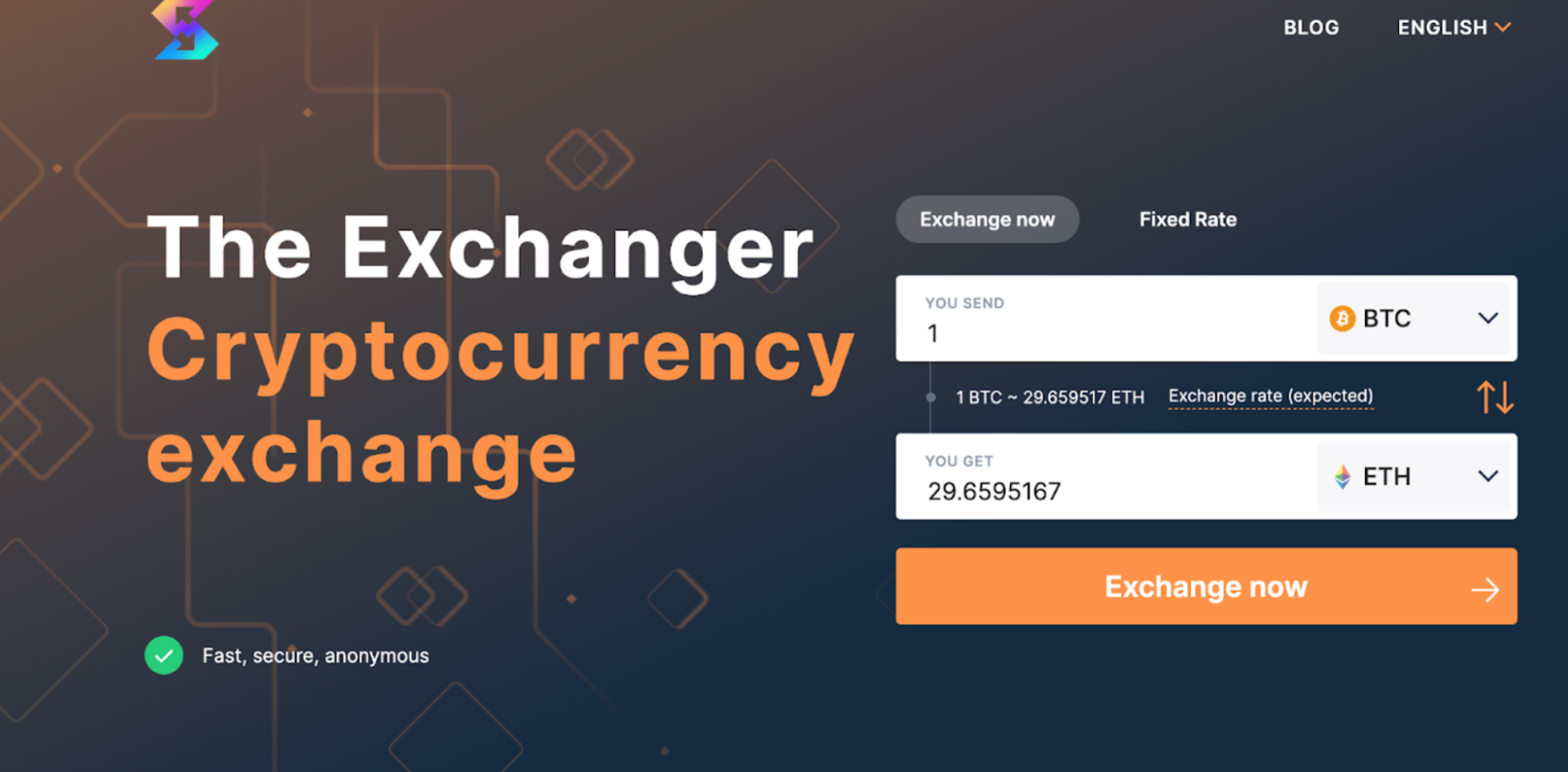
Example of a white-label interface where the underlying provider isn’t visible
Make your own crypto exchange with ChangeNOW
With the ChangeNOW API, you create cryptocurrency exchange website pages on your own domain and under your own brand, while ChangeNOW runs swap processing in the background. Integration is free. ChangeNOW helps in resolving stuck or repeated deposits and transfers sent to the wrong asset or network. You can withdraw earnings anytime in 11 cryptocurrencies or fiat.
How much does it cost to develop a crypto exchange?
For teams pricing how to build a cryptocurrency exchange, Gapsy Studio’s 2026 cost analysis puts a basic DEX at $80,000 to $250,000 and an enterprise CEX at over $1 million. An instant exchange on a ready-made API or white-label plugin integrates for free. Your spend goes to the website and legal setup.
| Model | Typical development cost | What you pay for |
|---|---|---|
| CEX, lean MVP | $150,000 to $300,000 | Matching engine and custody |
| CEX, mid-tier | $300,000 to $800,000 | Compliance workflows and mobile apps |
| CEX, enterprise | $1M+ | Institutional volume and complex regulation |
| DEX, basic | $80,000 to $250,000 | Smart contracts and audits |
| DEX, advanced | $250,000 to $600,000 | Governance and layered audits |
| Instant exchange (API) | Free integration | Website and legal setup |
Development covers only part of the cost of creating a crypto exchange. Plan for:
- Legal setup and licensing, which vary widely by country
- Security audits before launch and on a regular schedule after
- KYC/AML tools, usually billed per verification or per screened transaction
- Market makers or liquidity providers, if you run your own order book
- Support and compliance staff, paid every month the exchange operates
Crypto exchange regulation in 2026
Crypto exchange regulation in 2026 follows your users. The rules that apply come from the markets you serve, wherever the company is registered. This year the EU, UK, Japan, South Korea and Australia all rewrote theirs.
Since July 1, 2026, when the MiCA transitional period ended, only authorized exchanges may serve EU clients. Authorization comes from a national regulator under the CASP regime and works across the whole bloc. 213 companies in 23 countries held one by June 30.
Washington still has no federal exchange law. A Senate vote on September 15, 2026 blocked the CLARITY Act from moving forward, and the GENIUS Act deals with stablecoins alone. A US exchange collects money transmitter licenses state by state and registers with FinCEN as a money services business.
The FCA window for the UK’s new crypto regime opened on September 30, 2026 and closes on February 28, 2027. The rules take effect on October 25, 2027.
In May 2026, South Korea began requiring exchanges to reconcile balances every five minutes, with the Travel Rule applying to transfers of any size. Australia’s AFSL requirement for crypto exchanges followed on June 30. Then, on July 15, Japan passed amendments that place about 105 crypto assets under its Financial Instruments and Exchange Act. Insider trading rules come with the change, and running an unlicensed exchange can lead to up to 10 years in prison. Hong Kong, home to 12 licensed exchanges, is drafting rules for OTC trading and custody.
Security measures
Exchange security starts with the wallets that hold user funds and the people and devices that sign withdrawals. Attackers took more than $3.4 billion in crypto during 2025. Bybit lost roughly $1.5 billion of that in a single hack. The funds left through an Ethereum cold wallet. Standard controls include:
- Cold storage holds the bulk of user funds offline. The hot wallet keeps only what the day’s operations need.
- Outgoing transfers run through MPC or multisig. A transaction leaves only after several independent devices sign it.
- 2FA on withdrawals and admin logins.
- Each user gets a daily limit. Funds go out only to whitelisted wallets, and a newly added wallet waits out a hold period first.
- Monitoring runs in real time and catches odd outflows, along with deposits from high-risk sources.
- An outside firm audits security at least once a year, and again after each major release.
For an instant exchange, the attack surface shifts to your partner's account. Do protect the API keys and the payout address by using two-factor authentication.
Conclusion
A custom CEX needs six figures in development and the right license for each market it serves before the first trade. If the question is how to create a cryptocurrency exchange website and backend on a limited budget, an instant exchange on a ready API costs far less: integration is free, and launch takes weeks. Swap volume from that first version then shows whether a custom CEX is worth the investment. The ChangeNOW API supplies liquidity for this route, and the White Label Exchange plugin covers the website.


