

TL;DR
- Network fees pay the blockchain miners and validators; service fees cover routing and safety margins.
- ChangeNOW builds both network and service costs directly into the estimated rate upfront.
- You control your price certainty by choosing between a Floating or Fixed rate.
Network Fees Explained
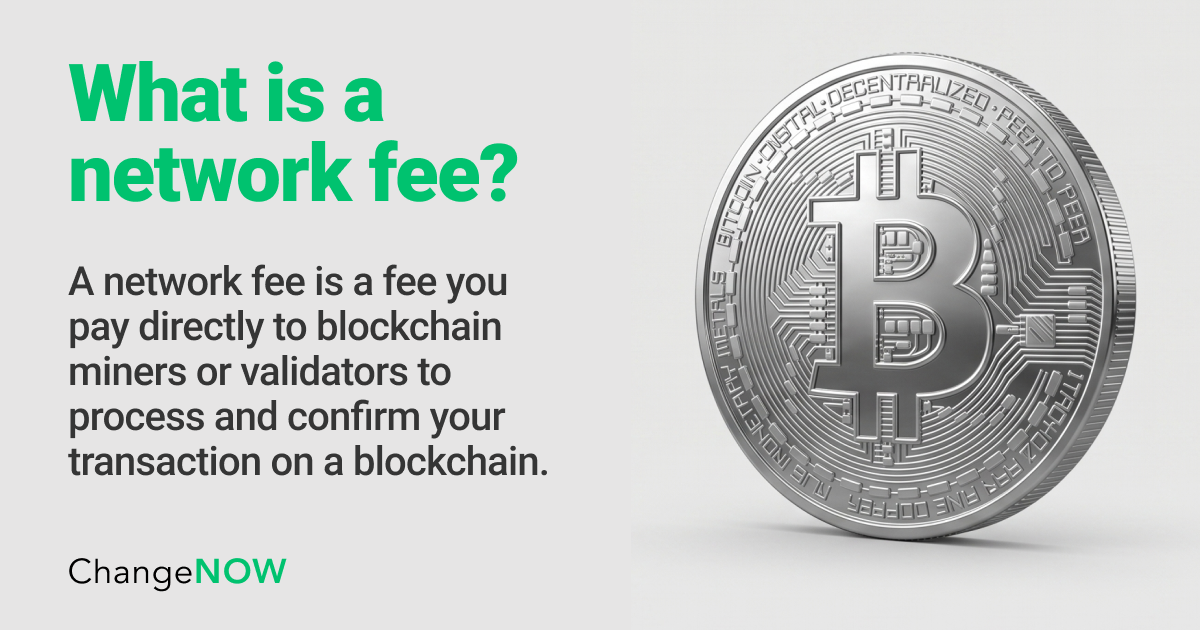
To understand ChangeNOW crypto fees, we should first separate the blockchain costs from the service costs. Every on-chain transfer starts with the network fee.
Miners and validators use computational power to confirm transactions and form blocks. A network fee is the mandatory payment they receive for doing this work.
The logic here is the following: the higher the fee attached to a transfer, the faster a miner will pick it up and process it.
Because blockchain traffic fluctuates, the exact cost is impossible to predict in advance. During periods of high demand, crypto transaction fees increase because users outbid each other to get their transfers confirmed quickly. This dynamic means crypto fees change by the minute based on network load and a number of other factors.
Wallets and exchanges often calculate a recommended rate to ensure a transfer completes in the nearest block to make the transaction go as smoothly and quickly as possible.
This payment never goes to the platform you are using. It strictly compensates the blockchain for processing the operation.
How Different Chains Calculate Fees
Let's look at the rules of the specific blockchain to understand the final costs better. For each network, fees are calculated differently. Here we’ll focus on Bitcoin and Ethereum since they cover the basics perfectly illustrating the two fundamentally different fee models in crypto:
- paying by data size → Bitcoin
- paying for computational effort → Ethereum.
Bitcoin
The Bitcoin network doesn’t care about the dollar amount you send.
Here crypto transaction fees depend on the transaction's size in bytes. A transfer that takes up more data space simply costs more.
When the market gets busy, people pay more to boost the transaction speed, pushing the overall miner fee up.
Ethereum and ERC-20 Tokens
Ethereum charges based on computing work.
As Investopedia explains: "Gas refers to the fee, or pricing value, required to successfully conduct a transaction or execute a contract on the Ethereum blockchain platform."
A simple transfer of native ETH takes a fixed, baseline amount of computing effort (for instance, 21,000 gas units). However, the price of that work, paid in ETH, goes up and down depending on how crowded the network is.
For ERC-20 tokens, the mechanism is different: interacting with smart contracts requires more complex calculations, so token transfers typically consume significantly more gas and vary depending on the specific contract.
You can check crypto gas fees in real-time using tools like Etherscan's Gas Tracker.
Notice the action types there: sending regular ETH takes less work than moving an ERC-20 token. Because token transfers require more computation, they naturally cost more. Knowing exactly what are gas fees in crypto helps you time your transfers during quiet hours to save money.
Next read: Received Less Crypto Than Expected? Here's What Happened
Fees on ChangeNOW
Key takeaway: You pay for two things during a swap: the network's toll and our service fee. We do not add separate, hidden charges at the end of your transaction. The estimated payout you see on your screen already has both of these costs fully calculated and baked in.
What fees are charged on ChangeNOW?
The fee you pay during a transaction consists of the network fee and the service fee, combined into the final payout amount displayed on your screen.
- The network fee: Blockchains charge for every transfer, and the price changes with traffic. A swap has network fees on both sides. When you send crypto to ChangeNOW, your wallet charges its own network fee. You see it before you confirm the transfer, and it’s separate from the amount you get in return. When we send your payout, we cover the withdrawal fee for you and then deduct that sum from the amount you receive.
- The service fee: This varies depending on the specific exchange pair you choose. While the exact size of the service fee is internal information, it is always fully calculated into your initial quote.
Important: Service fee is there not to just generate profit. It covers the actual expenses required to execute the swap safely, including the necessary internal routing and a safety margin to protect your funds against sudden market volatility.
By combining the network and service costs into one upfront estimate, we ensure the math is transparent and you never face unexpected deductions at the end of your swap.
How many fees do you need to pay for one swap?
There are always two fees: a network fee and a service fee.
Because the exchange happens on-chain, there are two separate transactions, and each one has its own network fee:
- Deposit: The cost to send your original coin to ChangeNOW. You pay this directly to the blockchain from your own wallet to initiate the swap.
- Withdrawal: The cost to send the new coin to your destination wallet. This crypto exchange withdrawal fee covers the final payout on the network.
ChangeNOW Smart Exchange Engine
Unexpected charges at the last step of a swap are a common and annoying problem.
On ChangeNOW, our service cost and the payout network fee are already built into the rate on your screen, so nothing gets added from our side after you confirm.
What you see is still an estimate, though: the market keeps moving until the swap is processed, and with a floating rate the final amount moves with it.
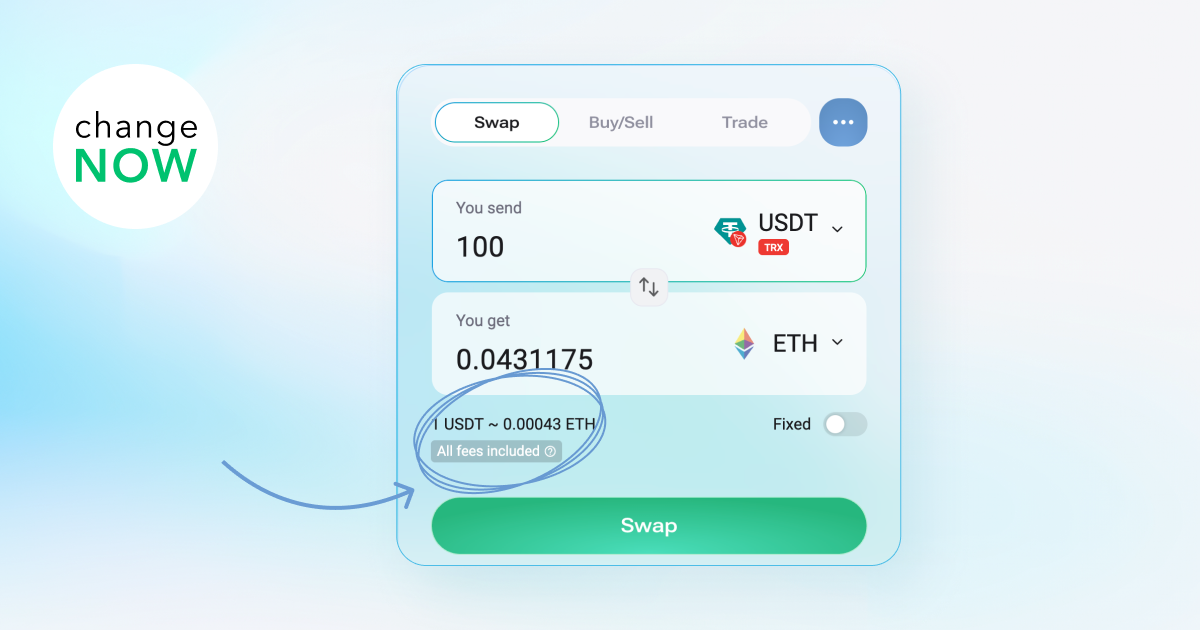
You control your swap by choosing between two rates:
- Floating rate. Behind your estimate, the system pulls from multiple liquidity providers to find the best current rate. Because crypto prices and network traffic change constantly, your final payout might shift slightly. However, according to ChangeNOW internal stats, about half of all floating rate trades on ChangeNOW match the original estimate or land above it.
If you notice a minor difference, our guide explains why you might receive less crypto than expected.
- Fixed rate. If you need an exact payout, this option locks your quote. You get exactly the amount shown, even if the market jumps around while your transaction processes. This protects you from sudden volatility, guaranteeing that the number you see is the number you receive.
You can read a detailed breakdown of these two modes in our fixed vs. floating rate comparison.
Wrapping Up
Blockchain networks require fees to compensate miners and validators for processing transactions. The key is knowing your total cost before you confirm a swap.
ChangeNOW includes both network and service costs directly in the estimated rate, rather than adding separate charges at the end. This allows you to see the final payout upfront.
Pro tip: When doing a crypto exchange fees comparison, focus on what actually arrives in your wallet. The amount you see before a swap is an estimate, and every service calculates it in its own way, so the real result of a swap is the only apples-to-apples number. Run the same small swap on two platforms at the same time and compare what you received.